OUR SERVICES

Straightforward care for every stage of a smile, from age 2 to 98.

2–98

Ages of patients we
currently treat

3, 4, or 6

Month recall schedule,
set per patient

~8 weeks

Typical implant
healing time

1 visit

Usually all a root
canal takes

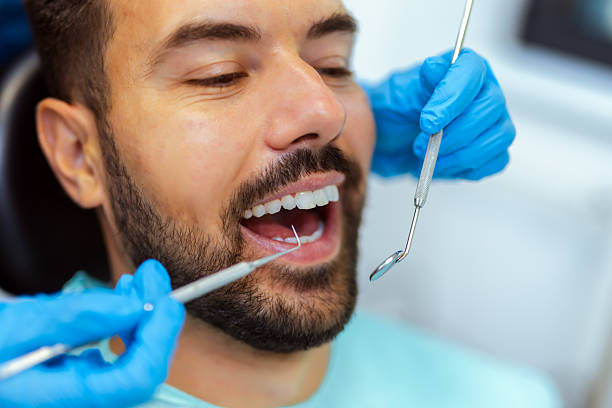
Man receiving a dental examination with a mouth mirror and dental probe.

General Dentistry

We see patients from age 2 to 98, and the plan looks different at each end of that range. For kids, the goal is making the visit itself unremarkable — building trust before they’ve had a bad experience anywhere else. For longtime patients, that sometimes means a shorter appointment, or a visit that works around health needs that have changed over the years.

Most people are on a 3, 4, or 6-month recall schedule, set by what your teeth and gums actually need rather than a default interval. Gum health is checked at every cleaning, since periodontal disease often has no symptoms until it’s advanced.

Recall visits every 3, 4, or 6 months, based on your needs
Yearly X-rays to catch decay forming between teeth
Full-mouth X-ray every 5 years to check bone health
Gum disease screening at every cleaning

Crowns & Fillings

Fillings are the simpler, less expensive way to repair a cavity. Silver amalgam holds up well on back teeth that take a heavy bite; tooth-colored composite is usually the better choice for front teeth and smaller cavities.

Once decay has taken too much of the tooth for a filling to hold, a crown covers and protects what’s left. Most crowns are tooth-colored; a few patients still choose gold on back teeth for the extra durability.
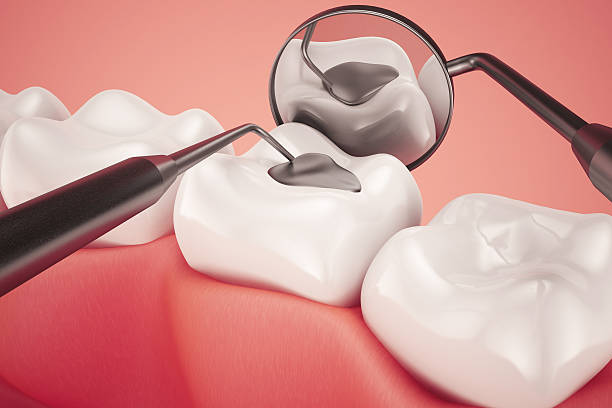
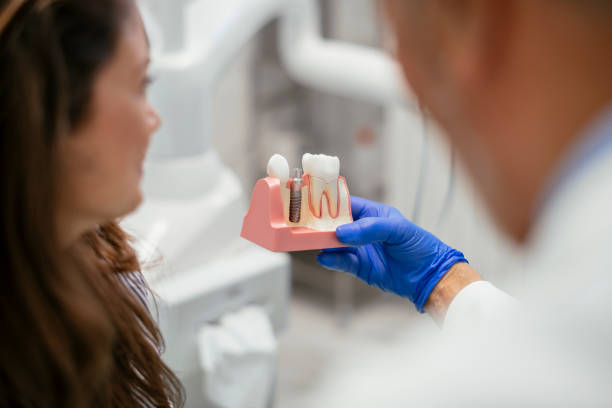
Illustration of a molar with a silver-colored filling being examined with a dental probe and mirror.
Dental professional showing a patient a model of a dental implant beside a natural tooth.

Dental Implants

An implant replaces a missing tooth from the root up. Dr. Seume places it and checks on the healing for about eight weeks before adding the permanent piece on top — a single crown for one tooth, or a bridge, partial, or full denture if more than one is missing. In some cases the implant itself is placed by an oral surgeon or periodontist, and Dr. Seume handles the restoration once it’s healed.

A bridge is the other option for a missing tooth: it’s anchored to the teeth on either side of the gap and is usually ready about three weeks after the first visit. It works well, though it does mean reshaping two healthy teeth to support it.

Cosmetic & Whitening

In-office whitening takes one or two one-hour visits and can lift teeth three to four shades — a good way to jump-start results before moving to take-home trays. For custom trays, we take a mold at your first visit, then fit and demonstrate the trays at your second, recording a starting shade to track against. Most people check back in every two weeks until they’re happy with the result, and can touch up at home whenever teeth start to dull again.

For straightening without full orthodontics, clear-tray retainers can shift one or a few teeth over two to six months, and veneers — including no-prep options like Lumineers — can correct color or minor crookedness without removing tooth structure or needing an injection. Dr. Seume also treats select adult orthodontic cases himself; more involved adolescent cases are referred to an orthodontist.
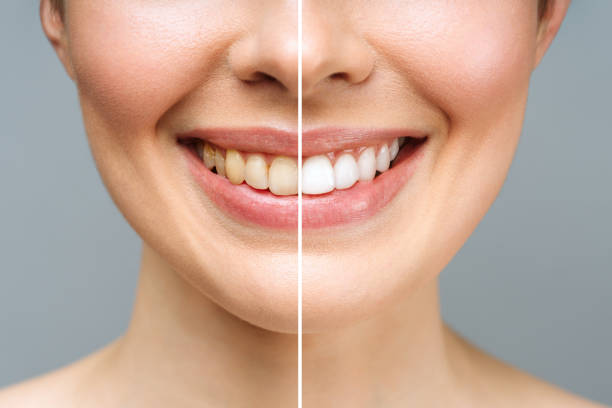
Split image of a woman's smile comparing yellow-toned teeth with a whiter tooth shade.
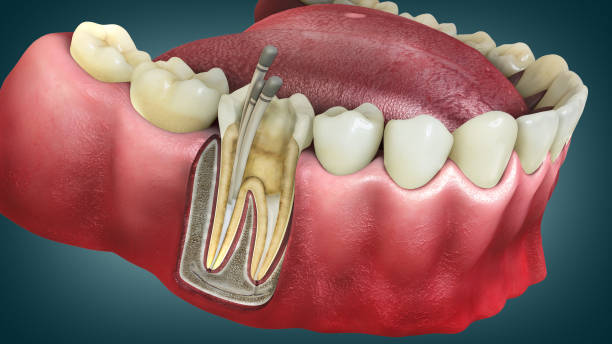
Cutaway illustration of a molar showing dental instruments inside the root canals during root canal treatment.

Root Canal Therapy

Once decay reaches the nerve, the tooth either has to come out or be treated with a root canal to save it. It’s usually finished in a single visit and more comfortable than most people expect going in — and it’s also the more affordable path compared to pulling the tooth and replacing it with an implant or bridge.

Dentures & Partials

When several teeth are missing along one arch, a removable partial — held in place with clasps on the remaining teeth — is often the simplest fix. When more extensive work is needed, a full denture is built from impressions taken over a few visits to get the fit and appearance right.

Dentures rely on suction to stay in place, which can be tricky, especially on the lower arch. Implants are increasingly used to stabilize a denture, whether you’re being fitted for the first time or you’ve worn one for years.
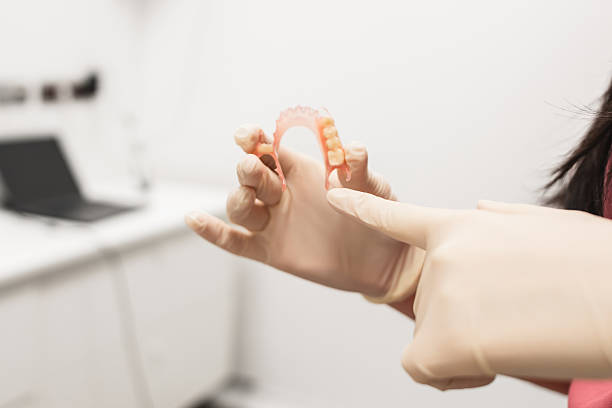
Gloved hands holding a removable denture and pointing to its pink base and replacement teeth.